

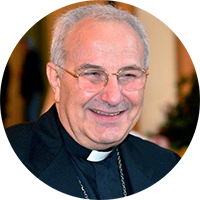

There’s the sensation that nowadays some processes are subjected to a peculiar acceleration. It is felt that many issues could soon come to a head and this arouses both fear and hope for some positive turning point. Our Observatory is committed to investigating these emerging issues, especially through its annual reports, but also with interventions on its website, such as the recent one by Prof. Gianfranco Battisti on the so-called WHO Pandemic Treaty. In this interview we do so with Monsignor Giampaolo Crepaldi, bishop emeritus of Trieste and careful observer of the processes underway both in society and in the Church, processes which he evaluates in the light of the Social Doctrine of the Church, main object of his interest and commitment. We ask him some questions about these speeding up tensions, thanking him for his availability.
Your Excellency, first of all, do you agree with our observation on the acceleration of many social processes, especially international ones, and on the possibility of significant turning points, which we hope will be positive but which could instead prove disastrous?
There are two wars going on, in Ukraine and in Gaza. We have ahead the European elections which could mark a very decisive watershed for a whole series of issues. Then the American elections… The health issue in its entirety is of great concern, as appropriately reported by Prof. Battisti’s article that you referred to. The so-called ecological and digital “transitions” seem to be reaching the point of decisive choices, one way or the other. Not to mention artificial intelligence. I would therefore say yes, very important choices will have to be made in the near future which will require profound wisdom.
Let’s start from Europe, which is closer to us. Our Observatory dedicated its 9th Report to the European Union with the title “Europe: the end of the illusions”, which contains very critical observations on the state of the Union. How do you see the next June elections?
I believe it will be a very politically important event. We know that the European Union Parliament is the only parliament in the world that does not legislate and therefore the elections may seem to have little practical impact. This time, however, I think it will go differently. European citizens have developed a critical awareness of the super-state and ideological tendencies of the Union government, especially in recent years. I am not afraid to say that this Union is very far from the fundamental principles of the Social Doctrine of the Church, especially that of the common good and that of subsidiarity. In particular, it is too subservient to ideological environmentalism and embodies a public ethic at odds with the needs of life and family.
How do you evaluate the positions of the Catholic Church with respect to the European Union? A few days ago the German bishops issued a statement asking not to vote for a far-right party.
When we talk about the Church we can mean many different realities: the Holy See is one thing, the Episcopal Commissions in Europe another, the Episcopal conferences yet another as in the case you mentioned. I cannot enter into all these areas here, but I can state in a general way that I notice a certain weakness in proposing the demands of the Social Doctrine of the Church in all the appropriate places in a clear, proactive way, while I see the will to pursue the agenda prevail set by the political leaders of the Union. I have the impression that the Catholic Church respects “good manners” too much and avoids touching some raw nerve in the political practice of the Union, for example by criticizing an evident ethical homogenization that the Union is imposing on nations, or discrimination against nations which are not completely aligned with Brussels.
As for the position taken by the German bishops, I believe that a national episcopate should intervene on political issues by presenting the principles, criteria of judgment and directives for action, without taking a position for or against a party. However, this should be done continuously and not just extemporaneously or, worse, instrumentally, and, above all, it should be done consistently.
I would like to return to the issues of the WHO, of the Pandemic Treaty that we would like to have approved next May and, in general, to the danger represented today by political management of healthcare. Are you worried or do you think the issue is not thought provoking?
This worries me quite a bit. And I hope that in the near future the issue will be addressed differently. Two are the most disturbing aspects. The first concerns “prevention” which is now being extended pervasively and which is based on the assumption that all citizens are permanently ill. This leads to direct political control of the population. The second is that the exasperation of this “prevention” takes on aspects of transition towards transhumanism. Why, instead of vaccinating everyone, don’t we reprogram the DNA of newborns? But going down this path would be very, very dangerous. I believe that the WHO Pandemic Treaty should be rejected and contested. There are too many signs that it would represent a point of no return in view of a health totalitarianism that will not only be about health.
Let’s continue on healthcare, in some sense. I would like to bring your attention to two very recent events. The first is that the Alabama State Supreme Court has recognized that frozen embryos are children. The second is that the “heartbeat” bill has arrived in the Italian Parliament, according to which the woman who requests an abortion should be made to hear the heartbeat of the child she is carrying in her womb. Do you want to make some comments?
The first consideration is gladness for these two initiatives. The battle against the “right to have an abortion” absolutely cannot be abandoned or even reduced in intensity. It remains an unavailable “non-negotiable principle”. After the famous ruling of the US Supreme Court which left the legislative decision on abortion up to the States, we unfortunately had the referendum in Ohio which confirmed abortion and now this ruling against it in Alabama. The road against State abortion is long and difficult but, as we can see, not impossible. As for the Italian Parliament, I think that the arrival of the popular initiative bill will force the parties to discover themselves on the issue of life. Left-wing parties are strongly in favor of abortion. I fear that even in the centre-right majority parties there are many supporters of abortion. This recently came to light in the Lega party, whose leaders said that abortion should not be touched. Even in the regions governed by this party, life was not adequately protected. The bill’s path through parliament will be bumpy, but we will truly see who stands with life and who doesn’t.
I would like to end this conversation by recalling that next July will be held in Trieste the Social Week of Italian Catholics dedicated to democracy. We will have the opportunity to return to the topic in the future, but in the meantime I ask you: what would you like from this Social Week?
The question is actually a bit premature… however I’ll mention a (provisional) answer. Augusto Del Noce wrote in the weekly “Il Sabato” on 11 February 1989 that the commitment of Catholics in politics must not be resolved in “bringing Catholics to democracy, as having in itself an autonomous value with respect to the religious foundation”. Well, I would like the Week not to do this, but to establish the Catholic conditions so that democracy is not understood as the foundation of government but only as a form of government. I would not like an exaltation of current democracy, but a strong criticism of it according to the criteria of the Social Doctrine of the Church, from Leo XIII to John Paul II.
Thank you Your Excellency
Stefano Fontana
